Bek Sunuu
What Has the Trump DEI Rollback Cost Black-Owned Businesses?
There isn’t a single, headline number for the total economic cost to Black-owned businesses since the rollback of federal and corporate diversity, equity, and inclusion (DEI) policies. No federal agency tracks that directly, and corporations are not required to disclose how much business they direct to diverse suppliers.
However, there is one place where the economic impact of these changes can be measured with real precision: federal contracting.
Unlike corporate procurement, federal contract activity is fully transparent. Every federal contract action and dollar obligation is recorded in public, down to the transaction level. That makes federal contracting one of the only places where the real-world effects of DEI policy changes can be analyzed using actual data rather than inference.
This analysis focuses on federal contracting not because corporate DEI rollbacks are unimportant, but because federal data is the only system that allows us to separate narrative from reality.
Why 8(a) is the right lens
Within federal contracting, no program matters more for Black-owned businesses than the Small Business Administration’s 8(a) Business Development Program.
The 8(a) program is the federal government’s primary contracting vehicle for socially and economically disadvantaged businesses. It provides set-aside contracts and sole-source awards that allow small firms to bypass open-market competition and access large institutional buyers.
Black-owned businesses represent one of the largest participation groups within 8(a). For many firms, 8(a) contracts are not marginal. They are the primary entry point into government procurement and often support payroll, bonding, access to credit, and long-term growth.
When 8(a) contract flow changes, revenue for these Black-owned businesses can change drastically. That is why 8(a) is the most defensible channel for measuring the economic impact of federal DEI rollbacks.
What Trump changed — and why it hits 8(a) directly
Two separate forces have recently impacted, and now shape, 8(a). One is legal. One is political.
In 2023, federal courts restricted SBA’s use of race-based presumptions of social disadvantage. SBA responded by requiring applicants to submit narrative proof rather than relying on group status or race. That ruling changed who qualifies and how. It affects the intake side of the program.
Trump’s return to office introduced something different and more immediate: a sharp reduction in the federal government’s contracting goals for disadvantaged businesses.
In January of 2025, as a priority, the Trump administration reset the governmentwide Small Disadvantaged Business contracting goal to 5% (statutory floor/minimum/requirement) from the 15% aspirational goal under the Biden administration. When coupled with Trump’s executive orders explicitly rolling back decades-long government DEI requirements for contractors, the signal becomes very clear. That is not an administrative tweak. It is a signal to every federal agency that disadvantaged business contracting is no longer a priority beyond the bare legal minimum.
Contracting goals drive behavior. They shape how many procurements are set aside, how aggressively agencies use 8(a), and how much effort contracting officers put into finding disadvantaged firms. When the goal drops, the flow of opportunities drops with it. This is true even for firms that are already certified and wouldn’t cause delay by going through the certification process with the SBA.
It is important to note that this kind of change does not appear instantly in the data. Federal contracting runs on fiscal years, which start on October 1. That is why the first clean place to observe the Trump administration’s contracting posture is October–November 2025, the opening of FY26.
Timeline: when the policy changed
How federal contracting timing works
The federal government operates on fiscal years, not calendar years.
For the federal government, each fiscal year runs from October 1 to September 30.
Agencies plan most of their contracting activity around those fiscal-year targets.
So, the relevant periods are:
FY2024: Oct 2023 – Sept 2024
FY2025: Oct 2024 – Sept 2025
FY2026: Oct 2025 – Sept 2026
When the policy change happened
In January 2025, the Trump administration reset the Small Disadvantaged Business (SDB) contracting goal back to the statutory minimum of 5% (this affects 8(a)). Before, the Biden administration had an aspiration goal (promoted throughout the agencies by the SBA) of 15% of contracting.
That change applied for the remainder of FY2025 (Oct 2024 – Sept 2025), but agencies were already operating under procurement plans and pipelines set earlier in the year.
Federal contracting does not change instantly. It changes, in general, when agencies build their contracting strategies around a new fiscal year.
That is why the first clean period to observe the full effect of the rollback is FY2026, which began on October 1, 2025.
What the data shows
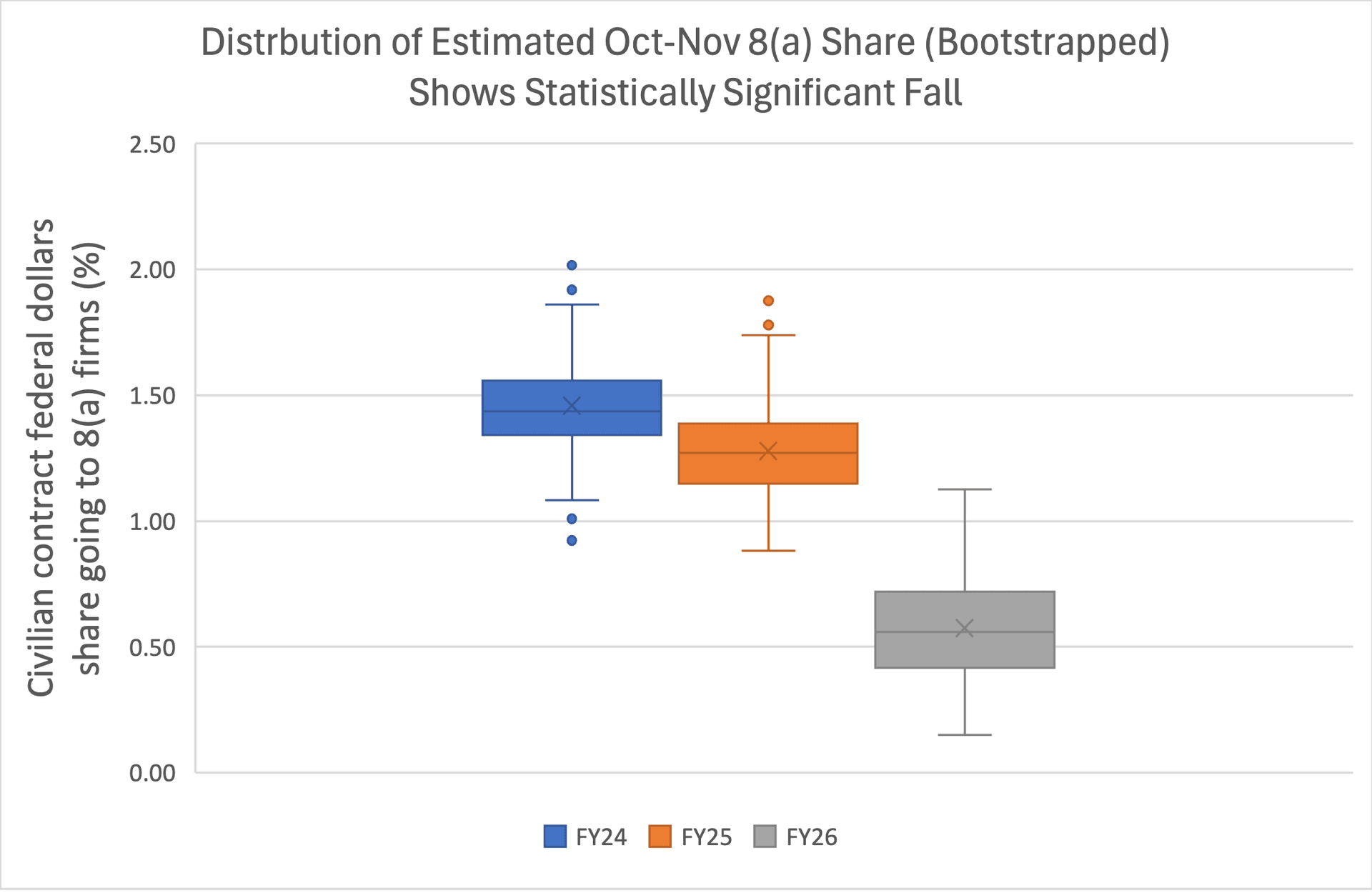
Using the full federal transaction ledger from USAspending, we measured the share of civilian agency contract dollars flowing through 8(a) set-asides during the same two months — October and November — across three years:
FY24 (Oct–Nov 2023) — pre-Trump baseline
FY25 (Oct–Nov 2024) — last pre-change year
FY26 (Oct–Nov 2025) — first months under the new policy regime
We use October–November because it avoids two major distortions in federal data:
September, when agencies dump money to close out the fiscal year
December, when accounting corrections and de-obligations spike
We also isolate civilian agencies because Department of Defense (DoD) contract data can be published with a delay of 90 days and would artificially suppress recent totals (we needed to be sure we were comparing apples to apples).
What we found is a break in the series.
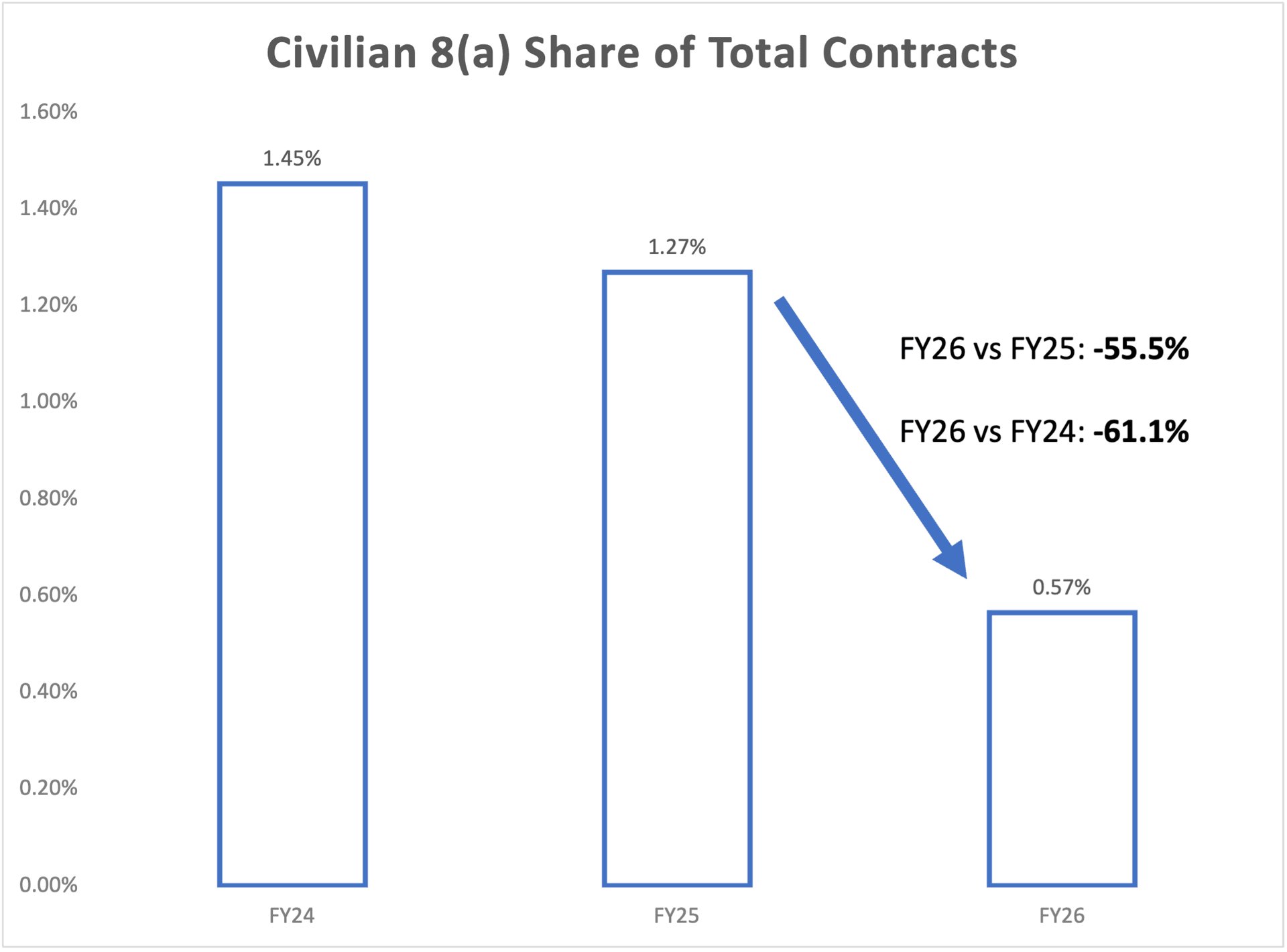
The share of civilian federal contract dollars awarded through 8(a) set-asides was:
FY24: 1.452%
FY25: 1.269%
FY26: 0.565%
This is an actual collapse.
FY26 is 55% lower than FY25 and 61% lower than FY24.
Chart 1: Civilian 8(a) share of federal contract dollars, Oct–Nov FY24–FY26
What that decline means in dollars
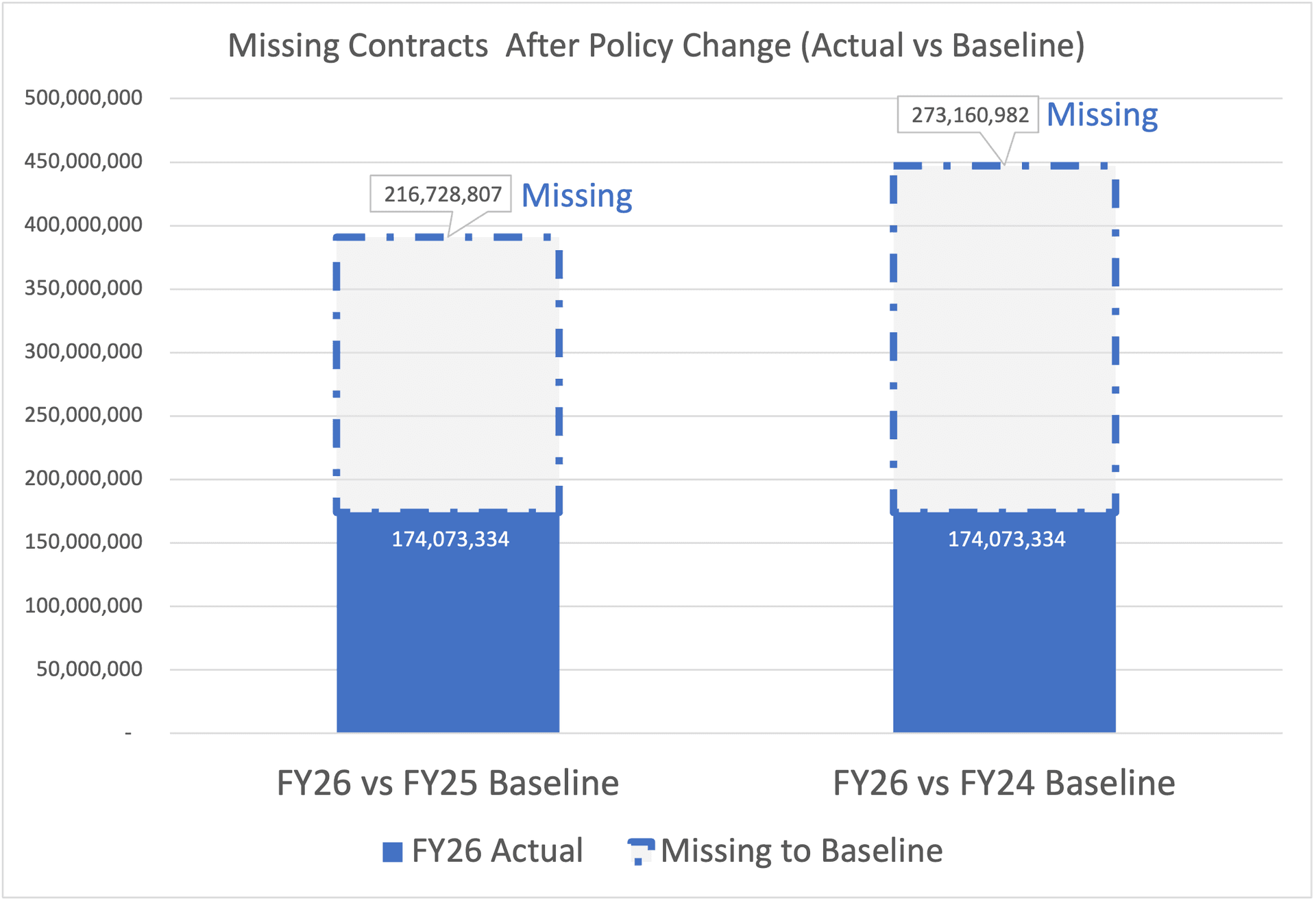
In October and November of FY26, civilian federal agencies obligated $30.8 billion in contract dollars.
If 8(a) firms had received the same share of that spending as they did in FY25, they would have received about $391 million.
They actually received $174 million.
That is a $217 million gap in just two months (annualized at $1.3B, if that rate persisted for a full year).
If FY26 had matched the FY24 pre-Trump baseline, the shortfall is even larger:
$273 million in October–November alone (annualized at $1.6B, if that rate persisted for a full year).
Chart 2: Expected vs actual FY26 8(a) dollars (civilian agencies)
That is real money that did not reach Black-owned and other disadvantaged firms [it’s important to note that this shortfall in 8(a) affects all disadvantaged groups under 8(a) (Black Americans, Hispanic Americans, Native Americans, Asian Americans, Subcontinent Asian Americans, and associated entities), not just Black-owned businesses].